

America loves to call itself a nation of entrepreneurs. Politicians routinely praise the family business, the independent contractor, the neighborhood store and the person who risks everything to build a company from scratch.
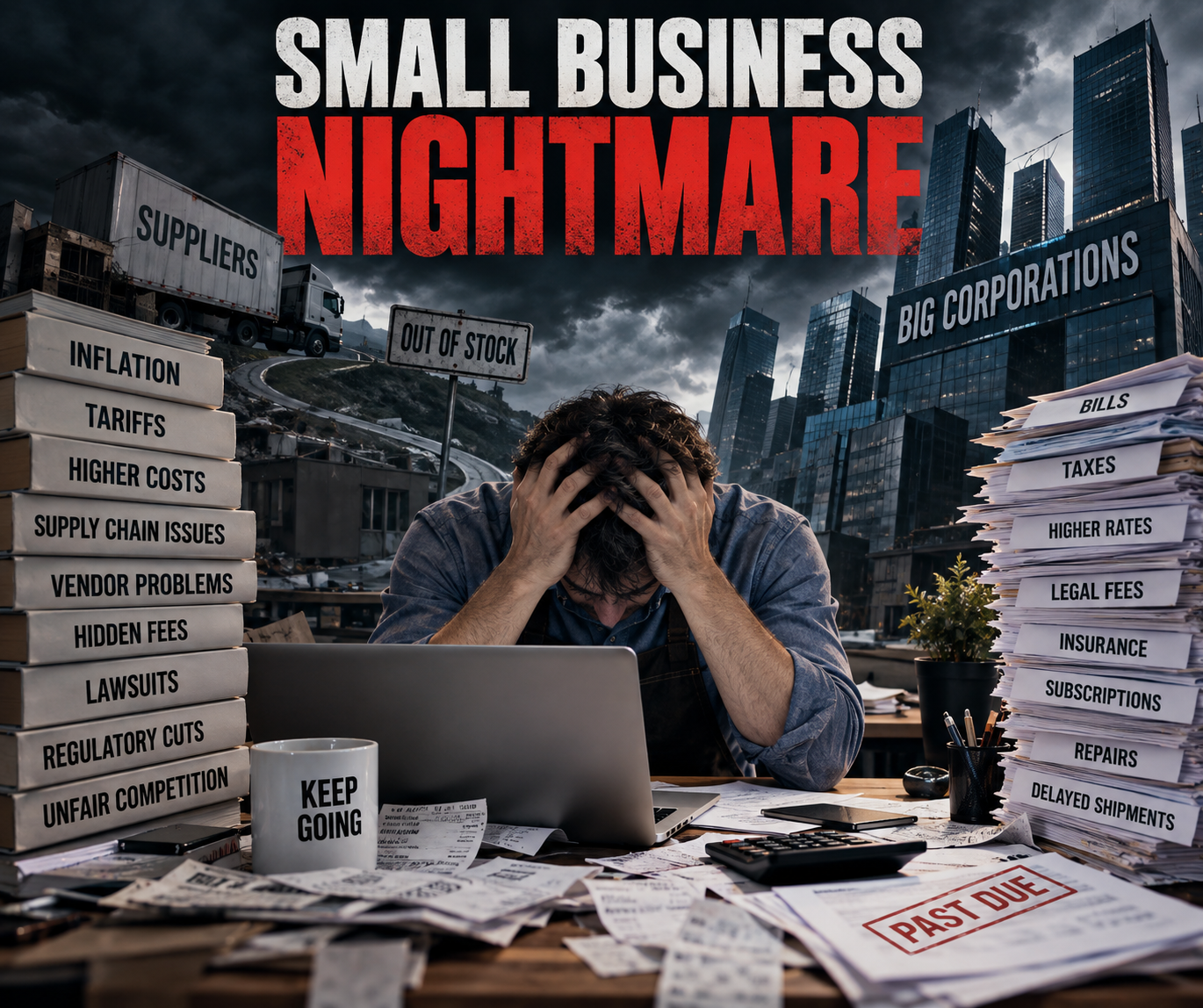
But being “pro-business” is not necessarily the same thing as being pro-small-business.
Under the Trump administration, that distinction has become increasingly important. Small businesses are confronting higher input costs from tariffs while simultaneously operating in an economy in which enormous corporations often possess purchasing power, legal resources, supply-chain leverage and access to capital that a small competitor simply cannot match.
The tariff problem is particularly well documented.
Federal Reserve researchers found that a majority of small firms in goods-producing and retail industries experiencing the new tariffs reported financial difficulties related to them. Roughly 80% passed at least some tariff costs to customers, while about 60% also absorbed some of the increases themselves. (Liberty Street Economics)
That second number matters.
A giant corporation may be able to renegotiate contracts, shift production between countries, order millions of units at a time or temporarily accept lower margins. A small business frequently cannot. The Boston Fed found that tariff-affected small and midsize businesses reported their average tariff rate rising from about 6.5% in January 2025 to 11.4% by July. (Federal Reserve Bank of Boston)
For the small-business owner, there is nowhere for that money to magically come from. Raise prices and customers may leave. Absorb the increase and profits disappear.
The economy increasingly rewards scale
Many of the other problems small businesses face did not originate with Trump. Market concentration and unequal bargaining power have developed over decades. But they become especially painful when government policy adds additional costs.
Consider what happens when a small company depends upon a giant manufacturer, software company, distributor, marketplace, payment processor or cloud provider.
The supplier can discontinue a product. It can change licensing terms. It can introduce a subscription. It can eliminate telephone support. It can prioritize its largest customers. It can impose minimum purchases. It can change an API, retire hardware or stop carrying a component.
The small business absorbs the consequences.
The FTC itself recognizes that concentrated markets can produce higher prices, reduced service and reduced innovation, and that supply-chain restrictions can sometimes make it difficult for smaller or newer companies to reach customers. (Federal Trade Commission)
That helps explain something many entrepreneurs experience as the “enshittification” of their vendors.
You pay more while receiving less.
Customer-service telephone numbers disappear. Support becomes an AI chatbot, ticketing system or offshore help desk. A critical problem sits unanswered for days. Sales departments respond immediately when money is coming in; support departments become mysteriously unreachable once the contract is signed.
Meanwhile, the small-business owner becomes the unpaid quality-control department.
- A shipment doesn't arrive? Track it down.
- Software stops working? Spend three hours troubleshooting it.
- A supplier substitutes an inferior product? Find another supplier.
- A manufacturer discontinues a component? Redesign your product.
- A product that once lasted five years now lasts two? Buy another one.
- An item isn't available locally? Drive around looking for it or spend hours searching online.
- A vendor goes dark? Start calling, emailing and documenting.
- None of that time appears on an invoice. But it is a real economic cost.
The corporation has another weapon: scale
Suppose a supplier has enough inventory for either a small customer ordering $20,000 or a corporate customer ordering $2 million.
Guess who gets the phone call returned first?
This doesn't automatically constitute illegal discrimination. Businesses generally have broad freedom to choose whom they deal with. Even antitrust law permits aggressive competition unless companies cross specific legal boundaries into exclusionary or monopolistic conduct. (Federal Trade Commission)
But legality doesn't make the playing field equal.
The same imbalance exists in litigation.
A small company facing a contractual dispute may have to ask whether it can afford $50,000, $100,000 or considerably more to fight. A corporation with an internal legal department can sometimes treat litigation as another operating expense.
Being legally correct and being financially capable of proving that you are legally correct are two very different things.
Then there are the subscriptions
Modern business has become subscription hell.
Software that once cost $300 becomes $49 a month forever. Features migrate into higher-priced tiers. Automatic renewals appear. Cancellation becomes difficult. Previously included capabilities become add-ons.
The problem became serious enough that federal regulators have repeatedly pursued deceptive recurring-subscription practices. The FTC continues bringing cases involving allegedly unauthorized or difficult-to-cancel subscriptions. (Federal Trade Commission)
For a household, another $20 subscription is annoying.
For a company running dozens of software products, services, cloud accounts, payment systems, security products and professional tools, recurring charges accumulate into thousands of dollars.
Protections are changing too
The Trump administration argues that it is making government more efficient and removing bureaucracy. Its SBA announced a restructuring that reduced the agency's workforce by 43%, while saying that core loan-guarantee, disaster-assistance and field operations would remain unaffected. (SBA)
That is an important distinction: reducing an agency's workforce does not by itself prove that small businesses have lost access to its core services.
But the scale of the reduction is significant, particularly when entrepreneurs already struggle to navigate financing, contracting and regulatory systems.
The administration has also substantially changed programs directed toward disadvantaged businesses. SBA reported that the share of prime contracting dollars going to Small Disadvantaged Businesses declined in FY2025 for the first time in a decade, although the government still exceeded its overall small-business contracting target. The administration describes these changes as eliminating race-based preferences and fraud; critics can reasonably focus on what the reduced participation means for businesses that previously relied upon those programs. (SBA)
This matters because minority-owned businesses already face documented financing disparities. Federal Reserve research has repeatedly found that financing obstacles can be more pronounced for women and minority entrepreneurs. (Federal Reserve)
That doesn't prove that every minority entrepreneur who receives poor treatment has been racially profiled. It does mean that eliminating programs intended to address documented disparities deserves scrutiny.
The small-business squeeze
Put everything together.
- The entrepreneur pays higher prices.
- The supplier provides worse service.
- The manufacturer shortens the product lifecycle.
- The software company adds another subscription.
- The distributor prioritizes the million-dollar account.
- The corporation can afford the lawyers.
- The small business spends hours chasing vendors who don't return calls.
- And tariffs can make imported alternatives more expensive precisely when an entrepreneur desperately needs more alternatives.
Then we tell that entrepreneur:
Compete.
That is the contradiction in America's supposedly pro-business economic philosophy.
Competition requires more than allowing somebody to file paperwork and open a company. Real competition requires markets in which smaller participants have a realistic opportunity to survive.
There is another side to the Trump administration's record that shouldn't be ignored. The SBA says federal agencies awarded nearly 28% of prime federal contracting dollars to small businesses in FY2025—above the statutory 23% goal—and approximately $179 billion in prime contracts went to small firms. (SBA)
So the evidence does not support the simplistic claim that every Trump policy is hostile to small businesses.
It supports a more troubling argument.
Some policies benefit small businesses while other policies—and especially tariffs—can impose costs that small firms are structurally less capable of absorbing than their enormous competitors.
The fundamental question therefore isn't whether America is “pro-business.”
It is:
Which businesses are our economic policies designed to help?
Because a policy that allows corporations to become larger, suppliers to become more concentrated and markets to become less competitive while independent businesses shoulder rising costs may be good for business in the aggregate.
That doesn't necessarily make it good for the small business owner trying to survive.
Post-COVID inflation didn't hit every business equally
The inflation that followed the COVID-19 pandemic was painful throughout the economy. But saying “businesses faced inflation” hides an important distinction:
A multinational corporation and a ten-person company do not experience inflation the same way.
When the price of fuel, electricity, insurance, rent, equipment, software, transportation, raw materials and wages rises simultaneously, a large corporation has tools available that a small business frequently does not.
Large companies can negotiate volume discounts. They can sign enormous long-term purchasing agreements. They can maintain multiple suppliers. They can shift production geographically. They can borrow money on more favorable terms. They can automate operations. They can employ dedicated procurement departments whose entire job is reducing costs.
- Most importantly, they often have greater leverage over suppliers.
- A small business buying 50 units asks, “What does it cost?”
- A corporation buying 500,000 units asks, “What price will you give us?”
- That difference becomes enormous during inflation.
Federal Reserve research following the pandemic documented that small businesses were particularly exposed to inflation because rising input and labor costs squeezed their margins. The Fed's Small Business Credit Survey also found that rising costs were among the most commonly reported financial challenges confronting small firms.
There is another problem: small businesses cannot always pass those increases along.
A giant national company may increase prices by a few percent across millions of transactions, renegotiate supplier contracts or temporarily accept lower margins in one division.
A neighborhood restaurant, independent retailer, contractor or small technology company faces a much harsher calculation.
Raise prices too much and customers leave.
Don't raise them and your margin disappears.
That creates an especially destructive cycle when inflation combines with higher interest rates.
The Federal Reserve responded to post-COVID inflation by dramatically increasing interest rates. That may help control inflation across the overall economy, but borrowing consequently becomes more expensive.
For small businesses, credit cards, revolving credit, equipment loans and working-capital financing can be essential tools rather than optional financial instruments. A large corporation may issue bonds, sell stock or borrow under favorable commercial terms. A small company may be financing operations through a bank loan, business credit card or the owner's personal credit.
So the small business can effectively get squeezed twice:
Inflation increases the amount of money it needs, while higher interest rates increase the price of obtaining that money.
Meanwhile, the corporation's enormous purchasing power can actually become a competitive weapon.
If a supplier is experiencing shortages, its largest customer matters most. If transportation capacity becomes scarce, volume customers have leverage. If inventory is limited, the company purchasing millions of dollars worth of merchandise has bargaining power that the independent business simply doesn't possess.
This is why post-COVID inflation should not be understood merely as prices going up.
It accelerated an existing imbalance.
The smaller the business, the more likely the owner is personally absorbing the shock—working additional hours, delaying purchases, accepting lower profits, using personal savings, searching for cheaper suppliers and spending time solving problems that a major corporation delegates to procurement, legal, logistics, IT and finance departments.
And every hour spent doing that is an hour that isn't spent developing products, finding customers or growing the company.
Inflation eventually comes down.
But the damage isn't necessarily reversed.
A supplier that raised its prices may never lower them. A subscription introduced during the disruption may remain. A cheaper product may never return. A competitor that went out of business doesn't magically reopen. A corporation that gained market share doesn't voluntarily surrender it.
For a large corporation, post-COVID inflation was an economic challenge.
For many small businesses, it became another structural disadvantage in an economy where scale increasingly determines who gets the lowest price, the best service and the greatest ability to survive the next disruption.
The “Big Beautiful Bill”: A tax cut isn't equally valuable when you don't have the money to use it
The One Big Beautiful Bill Act, signed by President Trump on July 4, 2025, illustrates another problem with America's definition of “pro-business.”
A tax policy can technically be available to businesses of every size while providing dramatically different benefits depending upon how much money a company earns, owns, borrows and invests.
The law permanently extended the 20% Qualified Business Income deduction for eligible pass-through businesses and restored 100% immediate deductions for many investments in equipment. It also restored immediate deductions for domestic research expenditures, expanded business-interest deductions and created favorable treatment for certain new manufacturing investments.
Those provisions can absolutely help small businesses.
But consider who is best positioned to exploit them.
- A struggling independent business trying to make payroll isn't purchasing a $20 million manufacturing facility.
- It may not have a research department.
- It may not be making enormous capital investments.
- It may have very little taxable profit from which to deduct anything.
- It may simply need enough cash to survive until next month.
Meanwhile, a highly profitable company planning millions or billions of dollars in capital expenditures can potentially generate enormous deductions from provisions allowing businesses to immediately deduct qualifying investments.
The Congressional Budget Office estimates that the 2025 reconciliation law's changes to business taxation will reduce federal revenues by nearly $1 trillion between 2025 and 2034, with permanent full expensing of qualifying capital investment playing a particularly important role in lowering the effective tax burden on investment.
Again, small businesses can use these provisions too. Research summarized by the Tax Policy Center actually indicates that bonus depreciation can increase investment particularly among smaller and financially constrained firms.
But there is an unavoidable mathematical reality:
You need money to receive a tax deduction for spending money.
A company purchasing $10,000 of qualifying equipment simply cannot receive the same dollar benefit as a corporation investing $100 million.
That produces an important distinction between tax policy designed around investment and policy designed around survival.
The small business struggling with rent, insurance premiums, payroll, credit-card interest, software subscriptions, tariffs and rising supplier prices doesn't necessarily need an incentive to buy another machine.
- It may need customers.
- It may need affordable credit.
- It may need a supplier that answers the telephone.
- It may need competitive markets.
And it may need enough operating margin left at the end of the month to remain in business.
Even the “small-business” deduction isn't necessarily going to small businesses
One of the bill's most important protections for independently owned businesses is Section 199A, which allows eligible owners of pass-through businesses—sole proprietorships, partnerships and S corporations—to deduct up to 20% of qualified business income. The 2025 law made that deduction permanent.
That sounds explicitly targeted toward small businesses.
But “pass-through business” and “small business” are not synonymous.
Large partnerships, wealthy investors and owners of highly profitable privately held businesses can also receive pass-through income.
Tax Policy Center estimates illustrate how unevenly the deduction's benefits can be distributed. In 2025, it estimated that about 10% of middle-income households would claim the deduction, compared with 43.5% of households in the top 1%.
More importantly, the estimated average tax benefit was dramatically different.
For middle-income households, the average increase in after-tax income associated with the deduction was approximately $60.
For households in the top 1%, it was approximately $32,000.
That doesn't mean the deduction is bad for small businesses. For many profitable small companies, making it permanent is valuable.
It demonstrates something different:
A tax provision labeled a business tax cut does not necessarily distribute its benefits evenly among businesses.
Corporations entered this era with another enormous advantage
The broader context also matters.
Trump's 2017 Tax Cuts and Jobs Act permanently reduced the federal corporate income-tax rate from 35% to 21%.
Unlike many individual provisions of the 2017 law that were originally temporary, that corporate reduction did not expire in 2025.
Many traditional small businesses, meanwhile, don't pay the corporate income tax at all. Their profits pass through to their owners and are taxed through the individual income-tax system.
The Big Beautiful Bill made the 199A deduction permanent, which helps reduce that disparity. But the fundamental difference remains: tax benefits often become increasingly valuable as profits and investments increase.
And that brings us back to the entrepreneur already being squeezed by post-COVID inflation.
Imagine two companies.
One is a giant corporation earning hundreds of millions of dollars. It has accountants, tax attorneys, procurement specialists and financial planners. It is building facilities, purchasing equipment, financing acquisitions and conducting research.
The other is a small business whose owner is trying to figure out why the insurance premium went up 18%, why a supplier increased prices again, why a software vendor just added another $79 monthly subscription and whether there will be enough money in checking to make payroll Friday.
Tell both companies they can immediately deduct qualifying capital investments.
Technically, they received the same tax incentive.
Economically, they live on different planets.
Tax policy can reinforce economies of scale
This is the larger problem with evaluating economic policy simply by asking whether it “cuts taxes on businesses.”
The relevant question is:
Which businesses are capable of capturing the benefits?
- A tax deduction based upon profits benefits businesses that have profits.
- An investment deduction benefits businesses capable of investing.
- An R&D deduction benefits companies capable of funding research.
- An interest deduction becomes more valuable to companies capable of obtaining substantial financing.
And sophisticated tax provisions are easiest to navigate when a company can afford accountants and tax attorneys dedicated to finding every available advantage.
None of this means the Big Beautiful Bill contains no benefits for small businesses. It plainly does. The Trump administration argues that permanent pass-through deductions, immediate expensing and other provisions will increase investment, wages and economic growth. The White House Council of Economic Advisers estimated that extending several business provisions would increase investment and GDP relative to allowing the earlier tax provisions to expire.
But that still leaves a fundamental question unanswered.
- What good is an investment tax incentive to the business that cannot afford the investment?
- What good is a deduction against profits to the company barely breaking even?
And what good is calling an economic policy “pro-business” if the businesses with the greatest profits, capital, purchasing power, financing and tax-planning resources are positioned to extract the greatest dollar benefits from it?
For the struggling entrepreneur, a tax deduction tomorrow doesn't necessarily solve a cash-flow crisis today.
And that is the recurring theme throughout the modern small-business economy:
The rules may technically apply to everyone.
But scale determines how much you can take advantage of them.
Immigration, DEI and universities: When Washington disrupts the pipelines small businesses depend upon
Not every threat to small business appears on a tax return.
Businesses also depend upon ecosystems: workers have to be available, entrepreneurs need access to opportunities and capital, and universities have to continue producing trained employees, research and technologies that eventually migrate into the commercial economy.
The Trump administration's immigration crackdown, dismantling of federal DEI programs and confrontations with universities potentially affect all three.
And once again, small businesses have less room to absorb the disruption than corporations do.
Immigration policy can become a small-business labor problem
Immigration is frequently discussed as a border-security or cultural issue.
For businesses, it is also a labor-supply issue.
Federal Reserve reports have documented businesses attributing worker shortages to tighter immigration policies, particularly in agriculture, construction, hospitality and manufacturing. In the St. Louis Fed district, contacts reported shortages and unusually high turnover that they attributed to the loss of immigrant workers. By October 2025, a Memphis construction company told the Fed that a reduced labor pool was increasing labor costs and delaying projects.
The effects have continued. In early 2026, the Minneapolis Fed reported a landscaping company saying immigration enforcement was significantly affecting its workforce and that replacements simply weren't available. The Fed also reported that some legally present foreign-born workers were avoiding work because of enforcement concerns, affecting hospitality and other businesses.
That creates a very different problem for a 20-person contractor than for a national corporation employing 20,000 people.
A large company has recruiters, HR departments, automation budgets, multiple locations and the financial ability to increase wages or relocate work.
A small business may simply have three people missing Tuesday morning.
If five workers don't show up at a giant corporation, it is an HR problem.
If five workers don't show up at a twelve-person company, it can become an operational crisis.
And immigrant participation in small business goes much further than labor. Immigrants are themselves disproportionately represented among entrepreneurs. SBA research found immigrants represented roughly 18% of employer-business owners and nearly 23% of nonemployer business owners. In accommodation and food services, immigrants owned nearly 37% of employer businesses.
So aggressive immigration policy doesn't touch only employees.
It can affect customers, contractors, suppliers and business owners themselves.
This does not mean immigration laws shouldn't be enforced. The administration argues that enforcement protects American workers and the integrity of the immigration system.
But there is an economic consequence that shouldn't be ignored:
If government rapidly removes workers from labor markets that already depend heavily upon immigrant labor without producing an alternative labor supply, somebody pays for that disruption.
For small businesses, that can mean higher wages, delayed jobs, lost customers and owners working even longer hours themselves.
The dismantling of DEI can remove pathways small businesses used to enter the market
The Trump administration has also fundamentally changed federal DEI policy.
In January 2025, Trump revoked Executive Order 11246 and ordered federal agencies to eliminate DEI-related requirements, programs and contracting practices. The administration argues that these programs created unlawful race- and sex-based preferences and that government contracting should instead operate through race-neutral, merit-based competition.
In March 2026, the administration went further, requiring covered federal contractors and subcontractors to certify that they do not engage in what the executive order defines as racially discriminatory DEI activities, with potential contract termination, suspension or debarment for violations.
There is a legitimate policy debate over whether previous programs produced equality of opportunity or impermissible preferences.
But there is also a small-business consequence.
For decades, minority-, women- and disadvantaged-business programs have attempted to address a basic problem: the company that already has the relationship usually has an enormous advantage over the company trying to get through the door.
Removing preferences does not automatically remove the underlying disparities in capital, professional networks, procurement relationships and access to decision-makers.
A small minority-owned construction company competing against a national contractor doesn't suddenly acquire the national contractor's banking relationships, attorneys, bonding capacity, purchasing discounts, political connections or decades of established procurement history because the government declares the competition race-neutral.
The rules may become formally equal while the competitors remain economically unequal.
And when programs designed to introduce smaller or historically disadvantaged suppliers into corporate and government supply chains disappear, some businesses can lose one of the few mechanisms specifically designed to get them into rooms historically dominated by established players.
Small businesses can also get caught in the new DEI compliance environment
There is another wrinkle.
The administration describes its policy as reducing bureaucracy. But companies doing federal work now must also understand where lawful nondiscrimination efforts end and prohibited DEI practices begin.
The March 2026 executive order requires covered contractors to police relevant practices not only internally but also among subcontractors, including reporting certain subcontractor conduct and providing records when requested.
- A Fortune 500 federal contractor can send that question to an employment-law department.
- A 30-person government contractor may be calling an outside attorney at $500 an hour.
Once again:
Compliance has economies of scale too.
Then there is the attack on the university research ecosystem
Trump's battles with American universities can appear unrelated to the neighborhood small business.
They aren't necessarily.
Universities aren't simply places where students attend classes. Major research universities are part of America's industrial research-and-development system.
Federal money finances laboratories and researchers. Researchers make discoveries. Universities patent inventions. Technologies are licensed. Professors and graduate students create startups. Small companies collaborate with universities. Those companies develop products. Larger companies eventually purchase or manufacture some of them.
NSF explicitly describes its Small Business Technology Transfer program as connecting small businesses with research institutions to move scientific discoveries from laboratories into the marketplace. Its SBIR/STTR programs provide early-stage funding specifically to startups and small businesses developing technologies that might otherwise be too risky for conventional investors.
That pipeline is economically significant. University technology-transfer data for 2024 showed more than $109 billion in research expenditures across reporting institutions, alongside extensive patenting, licensing and commercialization activity.
Disrupt the beginning of that pipeline and the effects can eventually appear much farther downstream.
The administration has argued that federal research money should be better controlled, aligned with national priorities and stripped of programs it considers discriminatory or wasteful.
But its actions have also produced substantial disruption.
The Government Accountability Office reported that NIH terminated more than 1,800 grants between February and June 2025 following administration directives affecting equity-related and other research funding. GAO subsequently concluded that NIH violated the Impoundment Control Act by withholding congressionally appropriated funds in connection with the funding disruptions it examined.
Some proposed reductions have also been blocked by courts, so it would be inaccurate to treat every announced funding cut as having taken effect.
But uncertainty itself matters.
- A laboratory doesn't know whether to hire another researcher.
- A graduate student doesn't know whether a project will continue.
- A university delays equipment.
- A startup doesn't know whether the research partnership it expected will exist next year.
- And investors dislike uncertainty.
Corporations can buy innovation. Small companies often have to grow it.
Here again, scale matters.
- A giant pharmaceutical company that needs a technology can acquire a company.
- A giant technology corporation can spend $20 billion on research.
- A defense contractor can operate enormous private laboratories.
- A startup may have three engineers, a university professor, an NSF grant and six months of cash.
- Take one piece away and the company may disappear.
That is precisely why programs such as SBIR and STTR exist. NSF describes them as mechanisms for funding high-risk technologies at their earliest stages, when conventional private investment may not yet be willing to assume the risk. The administration and Congress have also continued supporting this infrastructure: in 2026, NSF relaunched its SBIR/STTR programs with $250 million for startups and small businesses, an important counterpoint to claims that the administration is simply dismantling the entire innovation pipeline.
The concern is therefore broader than any single grant program.
It is what happens when immigration restrictions, research uncertainty and changes to programs intended to broaden business participation occur simultaneously.
Small business doesn't exist in isolation
A small company needs more than low taxes.
- It needs workers.
- It needs trained engineers, technicians and professionals.
- It needs universities producing research.
- It needs startups turning that research into products.
- It needs suppliers.
- It needs customers.
- It needs access to contracts.
- It needs financing.
And it needs some realistic mechanism for breaking into markets already dominated by companies hundreds or thousands of times its size.
Immigration policy can shrink particular labor pools.
Eliminating DEI-related contracting mechanisms can change pathways previously available to disadvantaged businesses.
Pressure on university research can disrupt parts of the research-to-commercialization pipeline.
Each policy can be defended individually on different grounds: border enforcement, race-neutral government, fiscal responsibility, academic accountability or elimination of waste.
But economic policy cannot be evaluated only by its intentions.
It also has to be evaluated by what happens when all of those policies collide in the real economy.
A multinational corporation can hire lawyers, recruit nationally, move employees, purchase technology, acquire startups, build laboratories and absorb temporary disruptions.
The small-business owner cannot.
And that is the pattern running through this entire story.
- Tariffs.
- Inflation.
- Interest rates.
- Supplier consolidation.
- Subscriptions.
- Litigation.
- Labor shortages.
- Reduced access programs.
- Research uncertainty.
Any one of those may be survivable.
Stack enough of them together, and America's celebrated small-business owner isn't competing anymore.
They're simply trying to survive.
The attention tax: When everybody is trying to sell you something
There is another business expense that rarely appears on an income statement.
The cost of constantly being sold to.
The modern small-business owner operates inside an increasingly aggressive commercial environment in which advertisements, sales calls, pop-ups, notifications, subscriptions, upsells, AI-generated solicitations and automated telephone calls compete continuously for attention.
Individually, these interruptions seem trivial.
Collectively, they represent an enormous hidden tax on productivity.
Consider something as ordinary as researching a problem on YouTube.
A business owner searches for instructions on repairing equipment, configuring software or learning how a product works.
- An advertisement plays.
- Then another advertisement.
- A sponsored promotion appears.
The creator interrupts the video to promote another product.
The business owner scrubs through the video looking for the thirty seconds containing the information actually needed.
Multiply that experience across YouTube, search engines, social media, news sites and other services increasingly used as legitimate business research tools.
The price isn't necessarily charged to a credit card.
The price is time.
Your computer increasingly resembles a shopping mall
The same phenomenon has migrated directly into business software.
- Install a product and suddenly there are notifications promoting another product.
- Open software you've already purchased and encounter an advertisement for the premium version.
- A feature that used to work becomes restricted to a more expensive tier.
- A startup screen promotes another service.
- A notification appears.
- An email follows.
- Then another email asks whether you saw the first email.
- Then a salesperson calls.
- Products that businesses purchase to increase productivity can begin behaving remarkably like adware.
This creates an absurd situation:
Businesses pay for software and then spend time dismissing attempts by that software company to sell them more software.
The Federal Trade Commission has documented a related category of manipulative digital practices known as “dark patterns”—interface designs that can obscure choices, disguise advertising, hide fees, steer users toward subscriptions or make cancellation unnecessarily difficult. In a review involving 642 subscription websites and apps, regulators found nearly 76% used at least one potential dark pattern and nearly 67% used multiple such techniques, although the review did not determine that every identified practice was unlawful.
That matters to businesses because businesses buy enormous numbers of digital services too.
Every confusing renewal, hidden setting, unwanted upgrade and difficult cancellation consumes employee time in addition to money.
Then the phone rings
For a small business, answering the telephone is important.
- It could be a customer.
- It could be a supplier.
- It could be an employee.
- It could be a prospective client.
So somebody answers.
“Hello, I'm calling about your business's eligibility for—”
Click.
Five minutes later:
“We can put your business on the first page of Google—”
Click.
Then:
“We'd like to speak to the person responsible for your merchant processing—”
- Then business financing.
- Then insurance.
- Then telecommunications.
- Then SEO.
- Then credit-card processing.
- Then payroll.
- Then another person offering something involving AI.
Automated dialing makes the economics extraordinarily favorable to the seller because computers can place enormous numbers of calls at negligible marginal cost.
But the economics are reversed for the recipient.
The caller spends almost nothing generating the interruption.
The business receiving it pays for the interruption with human attention.
The FTC notes that internet technology has made robocalling cheap and easy and that sales robocalls generally require prior written permission. Yet illegal robocalls and scams remain widespread enough that the agency maintains extensive consumer guidance specifically addressing them.
AI is industrializing solicitation
Now add artificial intelligence.
- AI can generate personalized sales emails.
- It can operate chatbots.
- It can qualify leads.
- It can produce marketing copy.
- It can automate follow-ups.
- It can generate sales pitches at enormous scale.
- These technologies can be extremely useful to legitimate businesses.
- But they also create an economic asymmetry.
- It might cost a company pennies to have an automated system contact 100,000 businesses.
- Those 100,000 businesses collectively have to determine whether the messages deserve attention.
- The cost of producing junk approaches zero.
The cost of identifying the junk does not.
And increasingly the recipient cannot immediately determine whether they're communicating with a human being.
- A convincing AI-generated email may require reading.
- An automated telephone system may deliberately sound conversational.
- A chatbot may spend several exchanges qualifying you before revealing that the entire interaction was a sales funnel.
The FTC has already encountered cases involving AI products marketed directly to entrepreneurs. In 2025, for example, it sued Air AI over allegations that the company made deceptive claims about business growth, earnings potential and refund guarantees, with some small-business customers allegedly losing substantial sums. Those allegations illustrate that AI can create risks not only through automation itself but through aggressive marketing of AI as the supposed solution to virtually every business problem.
The real cost is context switching
- Suppose an interruption wastes only three minutes.
- That sounds insignificant.
- But the actual productivity loss can be greater than three minutes.
- The owner was writing a proposal.
- The phone rings.
- They answer it.
- It's a sales call.
- They hang up.
- Now they have to remember:
- Where was I?
- What was I thinking?
- What was I about to write?
- That cognitive restart has a cost.
Now repeat the process with email notifications, spam, LinkedIn solicitations, advertisements, software notifications, pop-ups, cookie banners, upgrade prompts and automated calls throughout the day.
A corporation can partially insulate productive employees from this environment.
- It has receptionists.
- Procurement departments.
- Executive assistants.
- IT administrators.
- Spam filters.
- Legal departments.
- Purchasing departments.
- Vendor-management systems.
- Employees whose entire job is deciding which vendors deserve attention.
- At a five-person company, the person answering the sales call might be the CEO.
And the CEO might also be the accountant, salesperson, purchasing department, IT department and customer-service department.
Aggressive sales tactics transfer costs onto the target
This exposes another recurring feature of the modern economy:
Automation allows corporations to externalize the cost of selling.
Instead of paying a salesperson to carefully identify ten legitimate prospects, technology allows a company to contact 10,000 possible prospects and force those recipients to perform the filtering.
- The sender saves money.
- Everybody else loses time.
- The same principle appears in online advertising.
- Platforms monetize attention by inserting commercial messages between users and the information they're attempting to obtain.
- For someone watching entertainment, that is an annoyance.
- For someone using the platform to solve a business problem, it becomes a productivity expense.
- Likewise, a confusing subscription interface saves the vendor money if customers fail to cancel.
- A persistent upsell increases revenue if enough users surrender.
- A difficult cancellation process increases retention.
- A robodialer saves labor by making thousands of automated calls.
- An AI sales agent eliminates the expense of employing thousands of human salespeople.
- In every case, technology reduces the seller's cost partly by consuming somebody else's time.
The FTC's work on dark patterns demonstrates that regulators recognize at least the most deceptive versions of this problem. Its cases and reports have addressed disguised advertising, hidden charges, recurring subscriptions, confusing cancellation procedures and other techniques designed to steer users toward outcomes advantageous to the seller.
Small businesses pay an attention tax that nobody measures
This cost rarely appears in economic statistics.
There isn't a line on the income statement labeled:
Hours wasted dismissing advertisements.
There isn't another for:
Time spent determining whether an AI-generated email is legitimate.
Or:
Time spent answering robocalls.
Or:
Time spent finding the “No Thanks” button.
Or:
Time spent figuring out how to cancel something.
Or:
Time spent declining the premium upgrade for the product you already purchased.
But those costs are real.
If a business owner's time is worth $75 an hour and aggressive marketing, spam, advertising, unnecessary notifications and automated solicitations consume just 30 minutes each working day, that represents more than $9,000 worth of productive time per year.
At one hour per day, it approaches $20,000 annually.
And unlike a corporation, the small business frequently cannot hire another layer of employees to absorb it.
The owner absorbs it personally.
The scarce resource isn't just money anymore
This brings us to something conventional discussions of small-business economics frequently overlook.
- Capital is scarce.
- Labor is scarce.
- Credit is scarce.
But attention is scarce too.
The modern small-business owner is already trying to navigate inflation, tariffs, taxes, insurance, subscriptions, supplier problems, labor shortages, regulatory requirements, technology failures and competition from corporations with vastly greater resources.
Now add an economy in which thousands of other businesses possess increasingly sophisticated technology designed specifically to capture that owner's attention.
AI will make those systems cheaper, more personalized and more persistent.
The technology isn't inherently the problem. AI assistants, automated sales systems and digital advertising can create genuine efficiencies and connect businesses with products they actually need.
The problem arises when the efficiency exists primarily on one side of the transaction.
It becomes almost free to interrupt someone while remaining expensive to be interrupted.
For the corporation sending a million automated solicitations, that's efficiency.
For the small-business owner receiving them while trying to get actual work done:
It's another bill—except this one gets paid in time.